

Running a small business in Colorado means wearing a dozen hats, and retirement planning is often the one that gets pushed to the bottom of the pile. Between payroll, compliance, and day-to-day operations, owners frequently delay building their own retirement plan even while helping employees save for theirs. The good news is that Colorado small business owners have more retirement plan options today than ever before, and choosing the right structure can do double duty: building long-term financial security while reducing current tax liability.
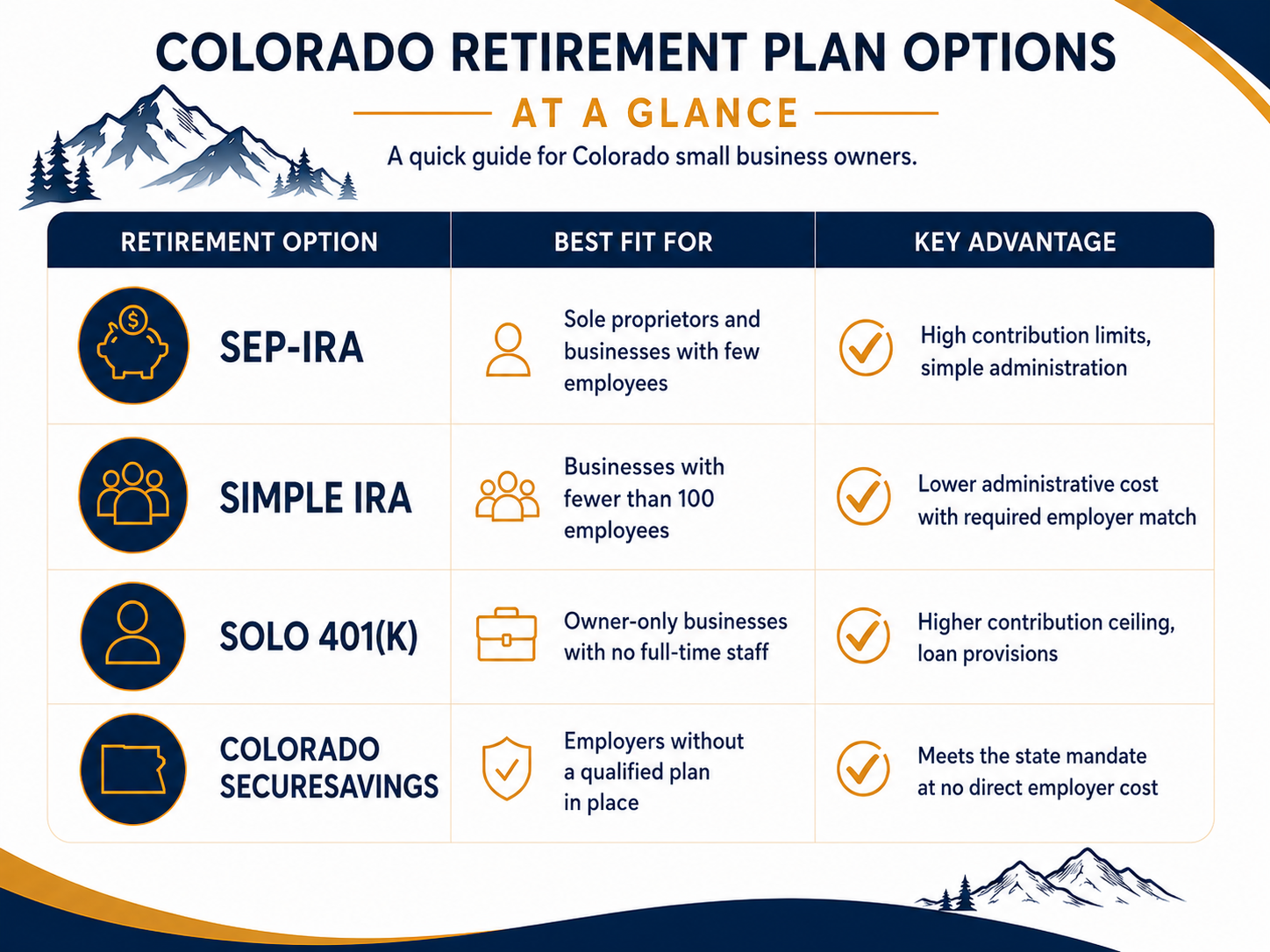
| Retirement Option | Best Fit For | Key Advantage |
|---|---|---|
| SEP-IRA | Sole proprietors and businesses with few employees | High contribution limits, simple administration |
| SIMPLE IRA | Businesses with fewer than 100 employees | Lower administrative cost with required employer match |
| Solo 401(k) | Owner-only businesses with no full-time staff | Higher contribution ceiling, loan provisions |
| Colorado SecureSavings | Employers without a qualified plan in place | Meets the state mandate at no direct employer cost |
Choosing among these options is not just a benefits decision, it is a tax and business strategy decision. A retirement plan structured properly can shift income, defer taxes, and support the long-term transfer of the business itself. This is where retirement and legacy planning becomes central to how Colorado business owners protect what they have built, both for themselves and for the people who will eventually take over.
Why Retirement Planning Looks Different for Colorado Business Owners
Colorado’s regulatory environment adds a layer that many owners in other states do not have to consider. Under the Colorado Secure Savings Program, most private employers with five or more employees that have been in business for at least two years are now required to offer a qualified retirement plan or enroll workers in the state-run Roth IRA program. That requirement changes the calculus for owners who had been putting off the decision. Instead of asking whether to offer a plan, the question has become which plan makes the most financial sense for the business and the owner personally.
For many business owners, this state mandate is actually an opportunity. Setting up a qualified plan such as a SEP-IRA, SIMPLE IRA, or 401(k) instead of defaulting into the state program can produce meaningfully better tax outcomes for the owner while still satisfying the compliance requirement for employees. Getting that structure right typically requires coordinating retirement plan design with broader tax planning, which is why strategic tax engineering and retirement plan design should be discussed together rather than treated as separate projects.
Best Retirement Plans for Colorado Small Business Owners
Most Colorado small business owners choose from a handful of established plan types, each with different contribution rules and administrative requirements.
| Plan Type | Employer Contribution Required | Administrative Complexity |
|---|---|---|
| SEP-IRA | Discretionary, must be uniform across eligible employees | Low |
| SIMPLE IRA | Mandatory match or fixed contribution | Low to moderate |
| Traditional 401(k) | Optional, subject to nondiscrimination testing | Moderate to high |
| Solo 401(k) | None required beyond owner’s own contributions | Low |
| Cash Balance Plan | Mandatory, actuarially determined | High |
Owners nearing retirement age or looking to shelter a larger portion of income often layer a cash balance plan on top of a 401(k), a strategy that can dramatically increase allowable contributions in the years leading up to a sale or transition. That kind of layered approach is rarely a do-it-yourself project, and most business owners benefit from a working relationship with an advisor who understands both the retirement plan rules and the surrounding tax picture.
Retirement Planning as Part of a Business Exit Strategy
For many Colorado business owners, the business itself is the largest retirement asset on the balance sheet, larger than any IRA or 401(k) balance. That reality makes succession and exit planning inseparable from retirement planning. Whether the plan is a sale to a third party, a transfer to family, or an internal buyout by employees, the tax treatment of that transition can significantly affect how much retirement income the sale actually produces.
Owners who start this planning early, ideally five to ten years before a target exit, have far more flexibility to structure the sale in a tax-efficient way, fund a retirement plan aggressively during peak earning years, and build a legacy plan that reflects their actual wishes rather than a rushed decision made under time pressure.
Colorado-Specific Resources for Small Business Owners
Beyond working with an advisor, several Colorado-specific resources are worth knowing about when building out a retirement strategy:
- Colorado SecureSavings Program, the state-run retirement savings option and compliance mandate for qualifying employers.
- Colorado SBDC Network, offering free, confidential advising for small business owners across the state, including financial planning topics.
- Colorado OEDIT, the state office overseeing small business support programs, incentives, and economic development resources.
Building a Plan That Works for Both the Business and the Owner
The most effective retirement strategies for Colorado business owners are never generic. A plan that works well for a two-person consulting firm looks nothing like the right plan for a twenty-employee manufacturing business, and the right answer often changes again as the business grows, adds staff, or approaches a transition. Reviewing the plan structure at least once a year, alongside tax projections and any changes in staffing, keeps the strategy aligned with where the business actually is rather than where it was when the plan was first set up.
Coordinating retirement contributions, entity structure, and exit timeline together, rather than addressing each in isolation, is usually what separates a plan that merely checks a compliance box from one that meaningfully changes the owner’s financial future.
Colorado Retirement Planning Guide: 5 Steps to Get Started
Building a retirement strategy does not have to happen all at once. Most Colorado business owners work through it in stages, starting with where the business stands today and ending with a plan for the eventual transition out of it.
Step 1: Assess Your Current Business and Personal Financial Picture
Before choosing a retirement vehicle, get a clear view of business cash flow, owner compensation, existing debt, and any retirement savings already in place. This baseline determines how much the business can realistically contribute each year without straining operations, and it often reveals whether income is being taxed less efficiently than it needs to be.
Step 2: Understand Colorado’s Retirement Plan Requirements
Confirm whether the business falls under the Colorado Secure Savings Program mandate. Employers with five or more employees that have been operating for at least two years must offer a qualified plan or enroll staff in the state-run Roth IRA. Knowing this requirement upfront shapes which plan options are worth comparing and which deadlines apply.
Step 3: Choose the Right Retirement Vehicle for the Business
Compare SEP-IRA, SIMPLE IRA, Solo 401(k), traditional 401(k), and cash balance plan structures against the business’s size, staffing plans, and how aggressively the owner wants to save. A plan that fits a two-person business rarely fits one with fifteen employees, so this step usually benefits from a side-by-side comparison rather than picking the first option that comes up in a search.
Step 4: Align the Retirement Plan With a Tax Strategy
Retirement contributions are one of the more effective levers for reducing current tax liability, but only when they are coordinated with entity structure, owner compensation, and other deductions already in place. Reviewing the retirement plan and the tax strategy together, rather than in separate conversations, usually uncovers savings that get missed when the two are handled independently.
Step 5: Build an Exit and Legacy Plan Around the Retirement Strategy
For most Colorado business owners, the business is the single largest asset feeding into retirement. Mapping out a sale, family transfer, or internal buyout years in advance, and coordinating that timeline with retirement contributions, gives the owner far more control over how much of the business’s value actually converts into retirement income.
Frequently Asked Questions
Reducing tax liability increases retained earnings, which can then be reinvested in the business. Over time, this strengthens the company’s financial position and increases its overall valuation.
Payroll relief refers to strategies that reduce the tax burden associated with employee compensation. This may include optimizing compensation structures, utilizing available tax credits, and improving payroll processes.
Many clients continue working with their CPAs. Our advisory services often complement traditional tax preparation by providing the strategic planning that occurs throughout the year.
Not at all. Small and mid-sized businesses in Colorado often benefit the most from proactive tax planning because it can free up capital for growth.
Tax strategies should be reviewed at least quarterly to ensure they remain aligned with current financial conditions and evolving tax laws.
Next Steps for Colorado Business Owners
Retirement planning for a Colorado small business owner is rarely a one-time task. It is an ongoing part of running the business, tied directly to tax strategy, staffing decisions, and the eventual transition out of the business. ABCats Inc. helps business owners bring all three pieces together, so the plan built today still makes sense years from now.